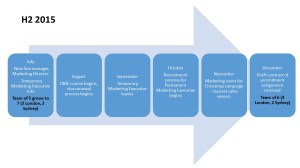
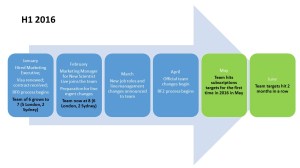
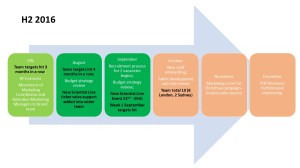
Participating in the DME course has provided a structured and supportive environment for me to analyze my personal growth and it’s relationship to my team, the business and how we together are accomplishing our growth goals. The timeline below highlights key changes over time.
Here’s how I’ve applied my learning from the course to grow New Scientist, RBI, my team and myself.
Managing Performance
- Personal motivation, emotional connection to work product and relationships and team dynamics are important to understand and consider.
- My immediate brand marketing team has changed rather dramatically in the last year, growing from 5 team members (3 in London, 2 in Sydney) to 8 current team members (6 in London, 2 in Sydney). I’m currently recruiting for 2 additional team members bringing the total in the next year to 10. Of the 10 team members, 7 of them will have been with the company for less than 18 months. There have been strategic alignments of skill sets and objectives to roles and projects within the team, as well as changes in line management and reporting. Through this, I’ve had to transition my own duties while maintaining my relationships and growing as a coach and mentor for staff who I recruited, but no longer specifically line manage. Understanding that teams take time to reform, normalize and then finally perform allowed me to set expectations appropriately, as well as guide people through the emotional aspects of changes within their employment.
- As a result the current team has feedback mechanisms to maintain performance, and have been hitting our subscriptions sales targets for the last 4 months (last 17 weeks as of September 2nd) after missing target from January until April. At August month end we have recorded a 33% year on year uplift in the amount of new subscriptions acquired at full price rates. We’ve recently expanded to now form a project team for New Scientist Live and it’s digital audience development through to ticket sales as a conversion end point.
- Team mates work best when they are engaged and working towards a common goal. Autonomy, enthusiasm and communication lead to success.
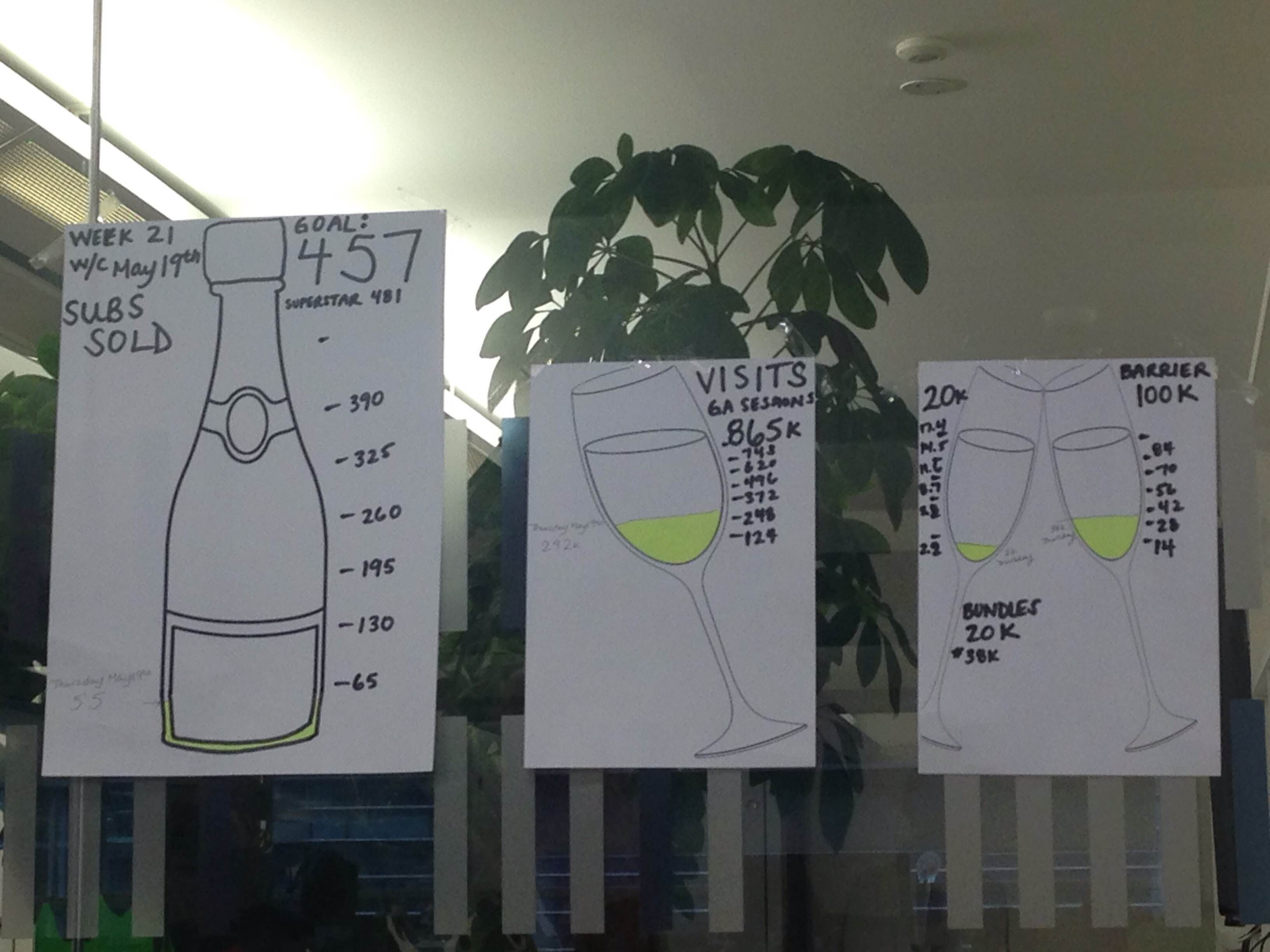
- Collaboration is required between the marketing, editorial and technology teams to deliver upon our defined key business metrics and sell subscriptions. By having two marketing team members in Australia, it means that we need to use multichannel communications to connect and get on the same page. At the end of April I introduced weekly KPI metrics for this collaborative team to achieve, that were stylized in the form of a celebratory bottle of champagne diagram. A daily stand up meeting with 8 wider New Scientist team members began in which we were measuring how we were performing each day, and what tactics individual team members were going to execute. A longer weekly meeting on Friday allows us to then plan further in the future and deep dive into any bigger weekly trends or areas for improvements.
- Initially it took 2 weeks for this system to normalize and hit weekly targets. We have not missed our monthly goals since. As a team we get together to recognize and celebrate our achievements every Thursday afternoon. After leading the stand ups for the first 6 weeks or so, I’ve now handed over that responsibility to other team members who rotate the weekly management. As of mid August, it was agreed that this same approach would be applied to New Scientist Live digital ticket sale activity with 7 weeks to go to the event.

Managing Careers
- Documentation and conversation through the personal development process at RBI and RELX allows for transparency and clarity of role objectives, as well as providing a basis for personal and organizational talent development.
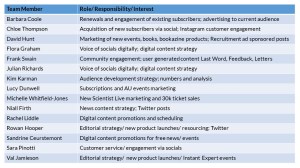
- Clarity of roles and understanding where unique value is added makes it easier for team members to move forward on their individual work, while understanding the network of stakeholders around them. As teams grow in size, location, skills and remits it is even more important that this growth is translated into actual business growth rather than lost in duplication, inefficiency and confusion. At the start of the year I began a consultative process with other senior marketing stakeholders in defining our team objectives and PDP goals for individual team members to ensure they were aligned. Our team PDP goals as entered in 2016 are shared. In the context of my role change, I moved from having 2 direct line reports to moving to a wider consultative role within New Scientist across our marketing, editorial, art, technology, sales and events teams. So while at the moment I don’t have direct line reports for PDPs, I have expanded my remit to other functional areas, and am currently in the recruitment process for 2 newly relocated brand marketing roles.
- This course has reiterated the importance of defining roles and responsibilities at the start of any team gatherings is a constant first step. Secondly, defining objectives and standards for measurement against those metrics is important. Having formal and informal means of communicating feedback on achievements against objectives creates an environment of transparency. I’ve applied this in the creation and/or maintenance of additional strategic project teams including:
- digital featured content amplification group – paywall or gated content continues to drive subscription sales. This cross functional group consisting of Feature editor, Digital editor, Deputy art editor, Deputy chief sub editor, Audience development executives and myself work together to maximize those subscription sale opportunities.
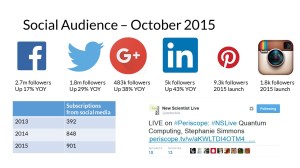
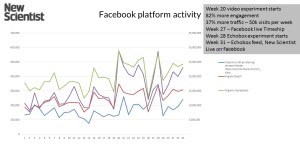
- social media strategy – social media of our top three drivers of traffic and has been growing 11% year on year in driving visit. The team of people who tactically work on social media is large, therefore there was a need to create a small strategy group of our Managing editor, Digital editor and news editor to resource and work dynamically to continue to drive growth as well as efficiency. I’ve introduced a new software tool that functionally posts the majority stories on Facebook and Twitter with algorithmic optimization. A role within the wider team that did this work on the digital team desk is not being replaced and the introduction of this artificial intelligence driven software has continued our trend of Facebook audience growth and conversion and allowed the remaining team members to focus on new innovations and adding value in driving audience engagement on our premium content.
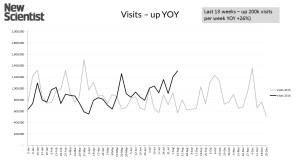
- website strategy – We relaunched newscientist.com in July of 2015 after a multi-year long project. As of February, monthly meetings are held with key stakeholders and more recently a new Head of Technology role has joined the team in May. Overall our website traffic, engagement and conversion to subscriptions have increased year on year cumulatively as of August.
- event team in the US – We are looking to expand our portfolio of events in the US. Given my previous experience 6 years ago in running events in Boston, I was asked to help recruit, hire and organize a new contract role for a Science Event Coordinator. As of the end of August, an offer was extended to a candidate who begins work imminently. My knowledge and experience within the RBI Human Resources systems and employment policies in the US has assisted in the quick hiring of this resource to run an Instant Expert: Relativity event in Boston on October 31st.








Managing Business & Customers
- Solving problems requires an explanation of root causes, not just symptoms.
- The Ishikawa diagram was a good framework for analyzing a very poignant challenge for my team at the time of the seminar. The New Scientist website relaunched in July of 2015 after a multi-year strategic project. Initially the site stability, functionality and user experience all contributed to challenges that had to be overcome, and our resulting commercial performance in selling subscriptions was down year on year and customer satisfaction with the new site was significantly lower. As a focused subscriptions marketer at the time, it was easy to see symptoms of why our site wasn’t working, but thinking about the root causes of the problem and sharing my thoughts with other stakeholders began a wider discussion on the trajectory of the project.
- A year later there have been substantial team and technology changes within our website, and we’ve been able to focus on short term versus long term strategic efforts by reviewing our metrics and performance on a wider scale each month and defining and prioritizing new developments based on commercial gain and customer feedback. We are on a trajectory for year on year growth should we keep up the momentum we’ve established in the last 3 months.
- Knowledge is power. Data is everything. Science wins. How you make people feel is part of the equation in gathering qualitative feedback. I firmly believed in these tenets prior to taking this course, but if anything, it gave me further confidence that my skill set and values is aligned with the growth of RBI as a data business and thought leader in providing quality information solutions.
- My new official role and title as of April 2016 is Head of Data Science, a job role and description I created that speaks to the importance of data in making decisions and driving further optimizations. To that end I’ve actively been employing new technology and overall awareness of artificial intelligence, automation, and natural language processing technologies, as well as customer segmentation and automated communication tools.
- The introduction of on website push notifications has driven traffic uplift (over 60k visits per week currently) and driving of subscriptions. The opt in rates and audience sizes are double that of our email newsletter, and drives an equivalent amount of subscriptions for less than a tenth of the cost.
- Trial and experiment of a software tool for automated social posting using an artificial intelligence platform has kept our social audience growing on Facebook despite the loss of a team member who had manually been completing this function.
- Managing business performance
- 3 year revenue forecasts
- Impact budget up
Managing Self
- I am my own best advocate and my own worst enemy – it’s important to take care of me.
- Learning and development at my current stage in career is largely self guided and self motivated. At the same time, its important to recognize how I can manage my own self awareness and
- This course was rather cathartic during the process of my secondment assignment contract extension and visa renewal process.
- Earlier in March, I was voted as my softball team captain, taking on additional responsibility in managing a group of 40 people. At the end of the season meeting last week, I was voted most valuable player, which was a lovely recognition for our team effort this year. I also organized the RBI charity softball event for the second year in a row with even more teams and increased money raised for local London charities.
- Knowledge is best shared.
- The course again gave me the confidence to know that the time and energy I spend networking and working with others is a good investment. By taking time to invest in relationships professionally, new ideas, shared learning and innovation can take hold more quickly.
- Some examples of knowledge sharing within New Scientist are:
- Examples within RBI/RELX data, marketing and technology communities:
- Women’s Network participation – communicating on Yammer and with Corporate communications
- Examples within the wider professional community:
 Kim Karman
You must be logged in to post a comment.